Showing posts with label father dunnes camp. Show all posts

Saturday, January 30, 2016

And Yes, He Does Get to Punch Somebody


Found a shrink-wrapped video of RKO Pictures’ Fighting Father Dunne (1948)  starring Pat O’Brien, the story of how Father Peter J. Dunne (d. 1939) in the early 1900s founded a home for homeless newsboys and cleverly obtained a building, money, beds, a housekeeper, and a pony to keep it going, by sweet-talking and hiring lots of Irish-born people. It’s a good movie except for its ending, which is probably entirely fictional.

The references to St. Louis locations are correct, and then-Archbishop Glennon is portrayed as having a severe manner but a big heart. The movie indicates that the newspapers were supposed to be caring for their newsboys. But they weren’t.

Father Dunne’s Newsboys Home and Protectorate expanded to include a camp. The Archdiocese of St. Louis can tell me only that the camp was established in 1941, the same year the property was acquired, two years after Father Dunne’s death. Boys first came to camp here on August 8, 1941, according to a letter held by the Archdiocese. A dorm was built and dedicated in 1957. The Archdiocese has no further information, nor do they have photos, maps, or other images. But I have some images.

Pat O'Brien does NOT wink like that in the movie.

Sunday, January 24, 2016

The Artifacts

Today I brushed the dirt and moss from the artifacts I took from the dig, and what I thought was a belt made of webbing is not a belt. That is not a belt buckle. It's a flat hook, 1/4" thick and very weighty. This is a flat hook ratchet strap, used for securing cargo. The entire length, from the fraying on its opposite end to the outer edge of the hook, is 32.5 inches.
Here is the cleaned "hinge," looking inside it. I am stymied, having very little familiarity with hardware. Could the hollow end have been a latch or something? If you know, please post.

It's just more mystery. I'm waiting for the soil to be diggable again. Patrick has a metal detector which could be a great help. Waiting also for the Archdiocese of St. Louis to send me information about Father Dunne's Camp, and I found and ordered a VHS of the RKO film Fighting Father Dunne (1948) so I can at last see the Father Dunne movie. I'm going to have to refer to this particular Father Peter J. Dunne as Father Dunne (d. 1939), because there are at least two other priests, more recent, with the same name.

Sunday, January 17, 2016

The Box, the Belt, the Hinge

Back today to the site of my mysterious ruin in the woods. Now in 20-degree weather with a dusting of snow, I had a broom and rake to help me uncover and measure the length and width of the ruin so far: 11 feet by 10 feet. Didn't bring a shovel or trowel; today, the soil was damp and my goal was getting the site cleared. I raked up a lid of a small white plastic box which shows damage, as if from heat, along one edge. It's packed full of earth. Then, uprooting and discarding clumps of grass growing between the concrete slabs, I found a woven belt, frozen and plastered with dirt and moss, its buckle well-rusted. (Click the photo to see the items in detail.)

Just as I was about to leave, thinking about the tools required for tomorrow, I noticed sticking up between the slabs a rusty man-made object. Ruining my gloves, I dug around it by hand. Really and truly it was stuck. It had a bend in it that forced me to dig deeper and in a different direction and discover that a tree root had anchored it in place. With all my strength I snapped this root and released the object. It looks like a rusty hinge, but I brought it back to the house to let the damp soil on it dry overnight, so I can clean it with a toothbrush tomorrow and give us all a better idea of what it looks like. I will also clean the belt. One more find in the dampish, nearly frozen earth looked like a finger ring. I hoped it was. But it was a pop-top ring. Those came into use in 1965; whatever happened to this site happened later.


Saturday, January 16, 2016

The Mysterious Dig, Part 1

Out for a quick walk in the woods, sleeves rolled up and bare-handed to try to get some sunshine although it's 41 degrees, I find, a little bit out of the way at the woods' edge where I haven't stepped before, a broken slab of concrete. Nobody would carry such a thing into the woods; there are no buildings in these woods. I brush the leaves from it and discover a second slab. Then a third. Then a fourth. Then a fifth. Digging and raking with my bare hands and a stick, I uncover more and more. A structure collapsed here. Then I found a rusty brace of some kind (outlined in blue), partway beneath a slab. Later I find a second one. It's a site. What is this place? What was this structure?

I found there also a steel tube, what I think was part of a gas line (outlined in green), sharply and deliberately bent at one end, exactly like the 50-year-old one at my house that was disconnected and deliberately bent so it could never be used again, when a new one was installed. I find a yellowish brick stamped "St. Louis" (outlined in yellow). Then I find what I think is a remnant of a vertical wall (outlined in pink); this material is different and more brittle, mixed with native stone. I keep raking right there, and just like a real archaeologist I find a shard of pottery; in this case, thick white institutional china, with dark-green stripes. Someone ate here. Was it a barbecue pit? It's too far from the dwellings, and too close to an old-growth tree, and if it had been a barbecue pit it wouldn't have gotten so large -- the site got larger as I uncovered more. I thought of going back for tools, but I'd dug enough for one day. Tomorrow I'll bring tools and a measuring tape and try to uncover the extent and solve the mystery.

There was also some synthetic material, very deteriorated and hardened (melted/burned?), and I'm showing a photo in case someone knows what it is--perhaps a form of insulation?

There was a boys' camp on this property, and I've heard tell of a chapel that existed pre-1957, when the dorms (now ruined, and a quarter mile away) were built. Could this be it? It does not appear in aerial views taken in 1954.

Monday, November 23, 2015

The Gate That's Gone


This property once had gates at its entrance on Highway F, with gateposts of pink Missouri granite. The gateposts had been wired to have lights on top, but I never saw them with lights. Only these two photos of the gate were taken, because within a year of my moving here permanently the gates were dynamited for highway widening. Today I found these printed photos from early summer '02 and wanted to show you and preserve some of the history of this place. The concrete top of one gatepost got dropped in the yard where it still is, sinking into the earth. I took a few bricks of pink granite as souvenirs from the rubble when the dynamiters were gone for the day. They actually did yell "Fire in the hole!," and pictures fell from the walls, and explosions at random every day for two weeks (we were honeymooning at home) made us jumpy.

Highway F was torn away down to rock, the rusty one-lane bridge destroyed, and the intersection was closed so that after work we either parked at the barrier and walked a quarter mile to the house, teetering on broken rocks, or drove an 8-mile detour to get to the house from the other side.

The highway department told the landlord it'd take the land by eminent domain if the landlord didn't grant or sell the 1 acre needed to widen the highway, shortening our lane by 20 feet. I think in exchange the landlord asked that the first 100 feet of the lane, from Highway F up to my house, be freshly paved. It sorely needed paving.

Friday, August 21, 2015

Doing the Deeds: Father Dunne's Camp

This property I live on was owned for 45 years by the Father Dunne’s Newsboys Home and Protectorate, a St. Louis Catholic charity that prefigured the more famous Boys Town. Dunne’s boys lived in the city but had a summer camp of 100 acres here. Dorm and dining facilities now in disrepair were dedicated in 1957, but exactly when the camp started, and who gave the land, was a mystery that sent me to the Jefferson County assessor’s office this morning, where I did the deeds, finally, after 14 years living here.

At the Registrar of Deeds, I found that the Father Dunne Newsboys Home and Protectorate’s camp had been sold for one dollar to the current landlord on 21 January 1986; the digitized records went back no farther. The older, oversized, weighty books of legal records, handwritten or typed, bound together by year, were in the archive. That room is chilly, and after the clerk copied me the 1986 deed, she pulled up on a monitor the digitized microfilm of all the Jefferson County deeds back to the 1860s and showed me how for each year I should search all the entries that began with the letter “F.”

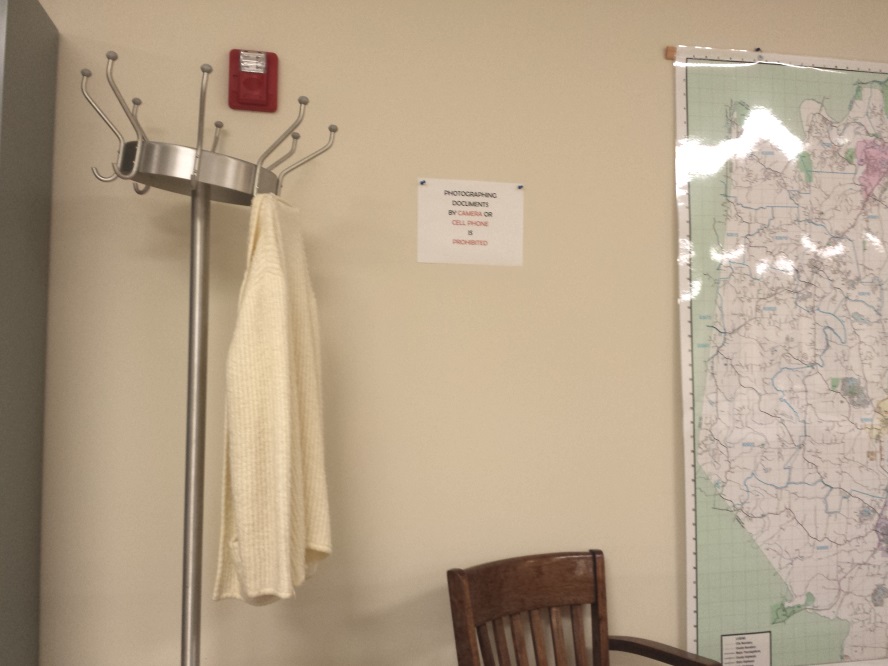
She’d worked with many historians and seekers. “People get cold in here, so if you need a sweater,” she said, then pointed to the coat rack where a lone cardigan hung, “use that one. That’s the ‘house’ sweater.” Only in Missouri.

The "house sweater" in case historians get cold.
Father Peter Dunne, an orphan who became a parish priest, sheltered his first homeless newsboy in 1906 and the shelter was running full tilt when Father Dunne died in 1939. “Old Newsboys Day,” Father Dunne’s fundraiser, is still held annually in St. Louis. Pat O’Brien starred in the RKO bio-pic Fighting Father Dunne (1948). Can’t find the movie. But I did find facts today about this 100-acre property:

-The house I rent was built circa 1935. It is 1070 square feet. The second house on the property was built circa 1960. There was a dorm-like building on this property in 1954, according to an Army Map Service topographic map.

-On March 31, 1941, Herman H. and Lillie M. Oberhaus sold 67.19 acres to Father Dunne’s Newsboys Home and Protectorate for $100. It would have been 80 acres total, but in April 1937 the Oberhauses had sold 12.81 acres of it to James R. and Gladys Murphy for $800. The price suggests that the Murphys bought a house on that property. In November 1938 a 15-foot easement was granted to Union Electric for electrification and tree-cutting.
-On June 26, 1942, William D. and Marie B. Walsh sold 40 acres to the Father Dunne Newsboys Home and Protectorate for $100.

As of June 1942 the Protectorate owned 107 contiguous acres and maybe established the camp then, but that doesn't explain the 1935 log cabin, built for summer residency. Perhaps the camp rented.

The property records are kept here.
The land was cheap because it’s good for nothing but a camp. Terrain is rocky, with dropoffs and steep-sided ravines and beneath an inch of soil is clay on sandstone. It’s so difficult that to this day AT&T refuses to extend its cable here.

Before today I knew only “lore” passed down through two previous tenants of my house (1986-91, 1991-2001), saying it was built around 1930 as the camp gatekeeper’s house. The keeper held the keys to the dorm, dining hall, and the gate, to which I held the key until it was dynamited for road widening in 2002. The camp closed in the 1970s, it is said because lots of little black orphan campers caused nearby residents to complain. Or maybe it was cost-prohibitive to remove the asbestos or bring the wiring up to code. Priests still used the camp’s pool as a vacation getaway in the 1980s; the first lease I signed required me to maintain the pool, covered and abandoned years before. The newer house on the property, my neighbor’s, is nicknamed “the monsignor’s house” and I need other records to learn who lived there.

Coincidentally, a friend had been a Father Dunne’s (later Catholic Charities) charge, living in the shelter downtown, and camped here in the summer of 1962; he was 12. Their baseball diamond was on LaBarque Creek floodplain now grown over, its backstop having collapsed completely about five years ago.

One day a man drove up saying he added the bedroom to the house in 1969. (It looks very 1969.) Another day an older priest drove up and wanted to revisit the property, if I said okay.

When the Jeff County assessor’s staff learned I was unraveling the story of my adorable house, they came forward with old files and photos that helped me more, plus the names of local historians, and which library held the books most likely to be helpful.