Showing posts with label labarque creek. Show all posts

Monday, May 3, 2021

A Mint

Wild mint is fun to find and harvest. There's a type that's poisonous, with white flowers on tall stems, but roll a stem between your fingers, and if the stem is square -- you will feel how it's square! -- you can have free mint leaves. There are six kinds of mint in Missouri. Although this is ordinary "ground ivy" (Glechoma hederacea) it smells wonderful. I found it creekside, in the hollow of a tree stump, its tree gnawed down by beavers long ago.

 
I had made a favorite India-themed pink lentil soup, and the recipe recommends a garnish of mint leaves. In winter I do without. How lucky I am in spring to simply walk down the road, onto the path I cut, and there was my mint, presented artistically for nobody's eyes ever, unless I happened to seek it out.

Tuesday, April 13, 2021

Bluebells by the Acre


Did you want to see bluebells growing in their native sort-of-swampy habitat, during the peak of blooming? Me too. Today I took happy advantage of the creek-side path I personally cut through the woods in fall and winter. The farther I walked, the more bluebells (Mertensia virginica) there were, to the left, right, ahead, behind. Golly!


Monday, March 8, 2021

Restoring A View: Before and After

Behold "before" and "after" pictures of an area of property that allows a view of our shaded double waterfall -- if, and only if, one will cut away a screen of invasive honeysuckle shrubs growing in the half mud-half sand where two nameless streams converge. The site is only yards away from where the confluence quietly empties into LaBarque Creek, beginning its long journey toward the Mississippi River.


How to accomplish this? One shoulders loppers, then crawls, then chop-chop-chops, thinking the labor is really a fool's errand because the honeysuckles will grow back, but a clear view of the double falls (operating best after a rain) is worth conserving. While I was cutting close to the rocks, I was privileged to see the very last of the ice and the first of the fiddlehead ferns. This is one of the lowest spots on the property, a micro-climate, even in hot summer noticeably cooler than anywhere else -- and in spring and fall, has breath that's sweet and positively chilly.

And of course I left standing the native Missouri trees.

I could go back and do a bit more, but I've adopted a philosophy that many male types I know practice with insouciance: 80 percent is honorable; it's good enough.

Saturday, January 23, 2021

On the Beach

Never cared for taking almost all my clothes off by the waterside, joining a bunch of strangers similarly undressed and all either yelling or playing dead. Can't swim and don't care for tanning. Given a beach (I have seen some marvelous lake and ocean beaches) I, in long sleeves and long skirt or pants, will hunt for shells or fossils, or take photos, or watch birds or other creatures. This on the shore of the mighty LaBarque, at one of its bends, is my ideal beach. It's private, the sand is soft, its crystals rounded; it doesn't stick to my parka and winter hiking pants when in January -- secretly overjoyed that the wheel of the year is turning toward spring -- I beat the bushes to get to my white sand beach, look for fossils on the water's edge for a while, sit down, sigh, and lie down on the sand that contours perfectly with my frame, viewing the sky up through the bare trees. Then shutting my eyes. Ahh.

Did this two days ago and attracted a big buzzard that flapped noisily away when it saw I was alive.

Thursday, October 29, 2020

Down the Road a Piece: A New Bridge


Since 2001 a thousand times on walks I crossed that crumbling concrete asphalt-topped Doc Sargent Road bridge across the creek, maybe 15 feet wide and 18 inches deep at that point, and maybe 50 times I waded beneath the bridge to hunt fossils, once scooping up a crawfish that bit me, a couple of times treading quicksand, and then after a storm one of the two ducts under the bridge got clogged with sand, and at the next serious rainstorm the mild-mannered LaBarque Creek began flooding in a foaming hurricane rush like I'd never seen, tore up stuff, then two years later did it again.

They're replacing that bridge. (Here's my 2018 post with a photo of the old bridge.) Work began in August. At 7 a.m. weekdays they're backhoeing and scooping and whatnot. Naturally I wanted to see, went over and asked a construction worker when they'd finish. He said, "Round Christmas." Here are some pictures. Where the bridge was is a tangle of naked, rusted rebar.

Considering that those toothpick-and-tar-paper new McMansions are built in two weeks from start to finish, they must be building a very good bridge here. Notice the pure-white sand. That's the sought-after St. Peters vein of sandstone than runs in a strip from Minnesota to here, and is still mined today in Pacific.

Tuesday, May 22, 2018

The Blocked Bridge on the LaBarque


Bridge over Doc Sargent Road
I've seen Roman aqueducts; they're very cool and they still work. This one on LaBarque Creek is more basic. I enjoy sidling down the sandy creek banks and hunting the fascinating fossils near this bridge on Doc Sargent Road. This area was once the shore of the great inland ocean, so the fossils are of marine plants. Imagine a time when plants, only plants, ruled the Earth! Was there love? Oh, there had to be! The rocks pictured below are from my latest hunt. Fortunately, fossils on rocks almost always lie fossil-side-up, making hunting a little simpler.

Yet this was the first time I actually  saw how one of the bridge's two ducts was clogged near to its "ceiling" with sand. Now I fully understand why in 2015 and 2017 the LaBarque, usually not much more than a stream, rose so quickly and forcefully over its banks and the adjacent road.

Seeing new and huge deposits of sand choking the creek, after those floods, did bother me, but it seems that Nature took care of them. This, though, I can't see a solution to.


Saturday, February 24, 2018

Creek is Rising

8:30 a.m., 24 Feb 2018
Dry winter has given way to about three days of rain. On Thursday it rained enough to brim the creek, LaBarque Creek. Then it rained that night. The next day I didn't look at the creek; I lolled. This morning after it rained all night (and another bout of rain approaching, according to radar) I was curious, because if the creek rises enough, it could be we're about to be cut off from the rest of civilization. The LaBarque was out of its bed and moving swiftly. I will post updates.

Friday, February 24, 2017

What's Under There? This.

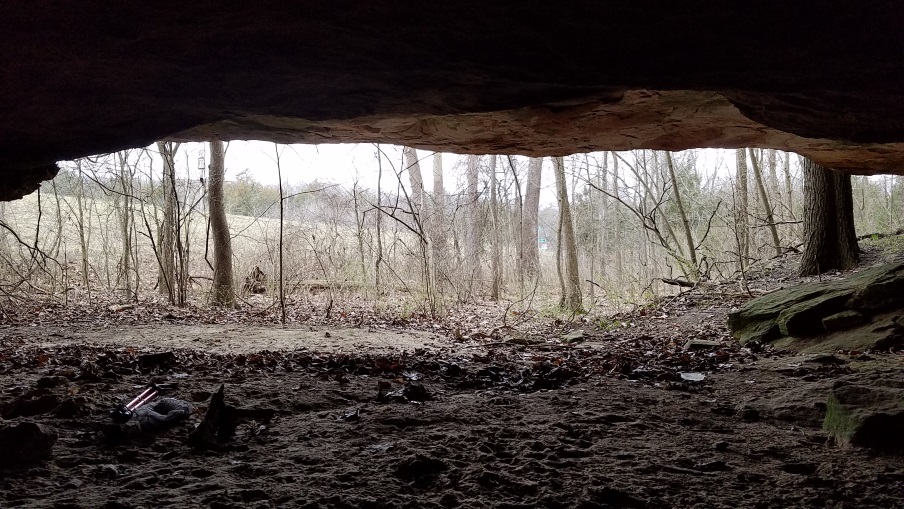
The Divine Cabin sits atop a bluff and from the road people can see, in winter and spring, what looks dramatically like a cave at the bluff's base. They actually park on the shoulder and walk on down there. It's so familiar I barely notice it, but I explored today so you can visit. In the above photo you can see in the left bottom corner my two three-foot hiking sticks, for scale, so the opening is about 30 feet.

The "cave" goes back about 20 feet, and although you can walk in you must stoop and then crawl and then meet a solid wall without portals, so it's not a cave but merely sandstone rock that is vulnerable at that layer to weathering. There's daylight enough inside for photographs. Because it's a sandstone bluff its flooring is sand with fallen chunks of solid sandstone (this presents danger and is why it's off limits), and animal tracks, mostly opossum. I found a bone about 10 inches long. What is a cave without a bone? The bone also had teeth marks (see the close-up photo). Before the flood of '15, a fox den was nearby--but beneath the bluff is not a good animal hideout because there's only one way out, and for the climbers, nothing to climb. Claws can't climb sandstone.

The bluffs were cut by LaBarque Creek when it was ancient and higher. The LaBarque is now about 40 yards to the west, beyond those trees. A fox's den will always be near water. The bluffs are wet and green year-round and they used to form a swampy pond ("the secret pond") at their base, full of frogs in spring and summer, so many they climbed the cliff and up the side of my house and stuck on the bedroom window. The flood of '15 thickly covered the creek's silty margins with sand and evened it out so there's very little pond area. A two-minute video I made way back when, in 2011, preserves it.

What you see from the road
Nearby I found a damp log with a few fresh oyster mushrooms that were in the pan 20 minutes later.

Friday, July 1, 2016

July 1

Always a special day in the middle of the calendar year, very early summer, delicious, paradise, dreamed about all year, and not yet so hot or droughty that it makes us lax or gives us headaches or the cicadas keep us up all night. So with appreciation, here's the creek and its creekbed wildflowers, Queen Anne's Lace and phlox and junk lily, and also an Allium head that's past peak but still beautiful, like so many people we know.

Sunday, June 26, 2016

I Bother a Snapper Turtle

Walking in the crisp early morning I met this Common Snapping Turtle (Chelydra serpentina) taking a break from a small man-made pond just a few yards from LaBarque Creek. I've seen a snapper twice as large, with much more algae on its shell, submerged in the LaBarque, and admired it for a long time as it patiently allowed fish to dart around its head, waiting and waiting for just the right moment to snap--waiting so long I thought maybe it didn't want me to watch, so I didn't stick around to see it. But that encounter let me know that our gentle creek is home to "snapper turtles," and I never step into the creek's deeper pools without first thinking of them.

As I back-and-forthed and circled around getting a good photo angle in the low-beamed early-morning sunlight, the turtle turned with me, facing me at all times.

Hunters are allowed to take Common Snapping Turtles during certain seasons, or if the snapper is causing damage to property (such as eating your goslings). How do you kill a snapper? I don't want to know.  The other Missouri snapper, the "Alligator Snapping Turtle" (Macrochelys temminckii), has a crenellated shell, with spikes sticking up, and it is endangered and protected by law.

Friday, March 11, 2016

LaBarque Creek Now, and Back Then


The photo with blue sky and snow was taken in January 2012, the other in March 2016. (It's the same leaning sycamore tree in both pictures.) The December 2015 flash flood here was like a flood of sand, creating new white sand "beaches" on the property, the result of gushing water, erosion and trees weakened and downed by invasive honeysuckle. Here's a brand-new "beach":

Looks appealing, but where you see sand there once was water. I climbed a cliff to to get a bird's-eye view of just how far the flood carried sand over the creek banks and into the woods:
When I first moved here in 1998 lavish white sand beaches lined the side of the creek where there aren't any now, and the water was deep enough to catch little sunfish. In 2001 and 2008 beavers built enormous dams just beyond the creek bend, and chewed down numerous nearby trees, destabilizing the creek bank on the near side; the flood of '08 destroyed the most magnificent beaver dam and greatest swimming hole I have ever seen. Beaver dam again in 2012. The current flood of sand means the creek is one foot deep. I never worry. Living here has taught me is that worry is all in the mind and utterly useless.

Monday, February 29, 2016

Peace I Ask of Thee

After the forceful Christmastime flood, LaBarque Creek has radically changed its course through the property, eroding its banks, and moving tons of rocks pulverized into dunes of pure white sand. I will need to visit at different times of day in order to obtain just the single photo image that'll show you just how striking are the huge new creekside "beaches" where there were none, new "islands" made of broken fossil rocks, and full-grown trees uprooted and fallen, creating new directions and chutes for the creek water, and also new depths, and therefore new colors--because for the last several years the LaBarque, as it passes through the property, has been shallow everywhere, lacking a swimming hole (last swum in 2008) or worthwhile fishing hole.

What you see here is a tree growing sidewise now, horizontally, a few feet above the water, out of a bank that has just about completely eroded beneath it, and the newly green creek water, deeper now than when it used to run gold. For some reason it looked like a Japanese print to me.

Early spring, right now, is the best time of the year, freshest (like a new book), full of light (with the trees yet leafless) and most heartening and promising.

Tuesday, September 8, 2015

September Morn

You remember that French painting, "September Morn," that so shocked everyone in 1912 that it got banned in America, and so on:
I'm finally coming forward to admit I am the model Paul Emile Chabas painted, having my bath in LaBarque Creek on a September 9 long ago.

Wednesday, March 4, 2015

Seasonal Fuzziness

Warm until February; snow and sleet in March: "Seasonal fuzziness" is what it's called by a Missouri Department of Conservation representative whom I heard speak about climate change (he said that he would not say "global warming" because that phrase was too  politicized). He said weather is drifting away from the calendar and our expectations because of man-made climate change. Yes, the weather is more and more confused; it's not a collective hallucination. Numerous outdoor events scheduled for March, when I'm often rhapsodizing about crocuses, have been snowed out, including a Mardi Gras dog parade ("Mardi Growl" -- everyone goes) in Eureka, and my planned jaunt to the back roads of  southern Illinois, inaccessible after a 7-inch snowfall. They rescheduled those events for April. Tonight it will be 0 degrees. This Saturday it'll be 52 degrees. LaBarque Creek (left), always pretty, looking like a poem, freezes and heats like a fever line.

Wednesday, February 11, 2015

The White Sand Beach

And the object of crossing the creek was to get to this beautiful and secluded LaBarque Creek "beach" and find a perfectly smooth spot and lie there in the sun, in sand so silky it doesn't stick to your clothes. It also makes great quicksand, which I've been caught in only once, in the LaBarque beneath a highway bridge.

Fortunately I'd previously read about quicksand. The impulse is to put all your weight on one leg, hoping to pull the other one out. But instead of helping, that leg sinks deeper, and vice versa. It's impossible to describe the sensation of suction from which you can't free yourself. 1) Don't panic. Areas of quicksand are mostly no bigger than a puddle and no deeper than a knee. In very slow motion -- don't tread or churn, it only makes it worse -- free one leg, and feel around with your foot or hiking pole until you find solid ground so you can -- again, slowly and steadily -- haul the other leg up and out, or 2) if that doesn't work, having tossed aside your backpack, lie back -- and either you will locate solid ground behind you or you will float. Yes, you'll float in quicksand; it's sand suspended in water. Lie back and your legs will eventually float upward. Then use extremely slow and gentle swimming motions to get to solid ground. Better yet, use your hiking pole(s) to test for firmness before stepping in unfamiliar wet sand.

Monday, February 9, 2015

The Eighth Waterfall

No day is truly rich and full unless you've fallen into a creek that day. In February, especially along the LaBarque, the tangle of underbrush and poison ivy is leafless (although not thorn-less), and I bushwhacked my way into territory unseen, possibly because the creekbed is always changing thanks to floods, weather, beavers, and fallen trees, and discovered on the property's southwestern edge this Waterfall #8. Shortly after taking this photo I crossed the brightly running creek by sitting on a spongy-wet fallen log and inching sideways to the creek's shallowest point, about six inches deep, where the water glittered golden and cold, and dropped myself feet first into the water, trusting my hiking boots and wool socks to keep me warm and mobile until I got back home. Which I did one way or another. Welcome to Waterfall #8. I love waterfalls.

Thursday, December 25, 2014

Light Like Christmas Cookies

How perfect: a sunny Christmas Day, 50 degrees, and eight off-trail hikers who met through Meetup.com, for various reasons all of us free on Christmas afternoon to explore LaBarque Creek Conservation Area and Natural Area, 639 acres, almost all forested, including seasonal waterfalls on LaBarque Creek tributaries. This was our second annual Christmas Day hike; last year's was snowy, cloudy, and icy. This year's had the pale yellow light of Christmas cookies. Recent rains allowed us to see running streamlets with green-and-gold pools up to three feet deep. We found that the Conservation Department has been sawing down red cedar trees, an invasive, non-native species, so that natural Missouri dolomite and sandstone glades can restore themselves. The downed trees made our going rough at times. But we were out for adventure. Above you see our leader, Kim.

I am always at the end of the line of hikers, about 45 seconds behind the rest despite my best efforts. This is called "being the sweep," and it is a job: The "sweep" makes sure the number of hikers leaving the woods is the same number that came in. One of us slipped on wet rock and fell, but it wasn't me; unfortunately he landed on, and broke the screen of, his cellphone.

(Excuse me--I have to go--the kitchen mousetrap just went "snap"!)

Friday, March 21, 2014

On the White Sand Beach


LaBarque Creek has beaches of pure white silica sand; I sunned myself on one yesterday, the first day of spring, and gave thanks, and watched crayfish in the creek water: Their presence indicates that the water is pure. Wanted to catch one and take its photo for you, but last time I grabbed one the creature pinched my palm (ow! like a needle!) and I dropped it into the water pronto. The creek water is low, leaving several sand bars and small islands, so I said, "There's something interesting on this beach; I'll find it," and leaped the creek back and forth hunting fossils until I came upon this prehistoric-looking creature, an armadillo, the first I've seen this year. They dwell near water, needing a lot of water to drink, and a predator likely caught it off guard and attacked, but found it wasn't able to get at any meat, so left it whole, and it was quite fresh. Always I remember my dictionary saying, in words of one syllable, "Their flesh is good food." Probably because they drink lots of water. I was sorry it had lost its life, but could approach it now without disturbing it (or risking a pinch) to be fascinated by his armor's artful design. They have become common here only in the last ten years.

Saturday, November 23, 2013

Fossicking a Brachiopod

As a gatherer in a month without mushrooms, vegetables, fruits or nuts, I am drawn to the LaBarque Creek streambed 50 yards away and entertained by fossils from the Ordovician Period -- 400 to 500 million years ago, when Missouri was underwater, specifically warm seawater. I found today the imprint of an ancient living creature, a simple clam-like bivalve called a brachiopod. As the first human being to lay eyes on it I never know what to say. It's an honor to meet this bookmark in time. Did it know it was beautiful?

"Fossicking" is a British-ism for "searching for gemstones among matrix rocks," but I like applying it to the enjoyable pursuit of fossil hunting. Have found fossils of marine plants and coral and creatures such as this brachiopod. Fossicking is made easier by the amazing fact that rocks with fossils and imprints usually lie on the ground fossil-side up.

Tuesday, August 20, 2013

I'm Warty But I'm Not a Toad

I'm a Blanchard's Cricket Frog (Acris crepitans blanchardi Harper); you can tell by the garters around my thighs. Although I'm warty and tiny (never more than 1.5 inches long), I am a frog, not a toad. Between my back toes is webbing, and my skin is more slick than dry. I am beautifully painted and camouflaged, and today I modeled for a large ungainly land animal who spent 15 minutes sitting uncomfortably on rocks at the edge of LaBarque Creek and pointing a pink thing at me.

Me and my homies sing in chorus on spring and summer nights. The warmer it is, the more we sing. When approached, we jump into the water, but our favorite place is the shore, where we eat crawling insects. What else do you want to know?