


Please listen and if you know what it is, tell me! It was about 10:00 p.m. This is a one-minute excerpt but it lasted several minutes. There is nothing to see--just to hear. Owls? Birds? Murder?
Showing posts with label woods. Show all posts
Showing posts with label woods. Show all posts
Saturday, April 15, 2017


Monday, October 24, 2016
Happy Hunting Grounds

I said it was edible but I'd leave it there because I had my year's supply, and Carmel, who'd never seen one in the wild before, to my surprise said, "I want it. I'll take it." So we cut it from the earth, and I explained its anatomy and how to cook it (break or cut it into florets and sautee or roast like cauliflower), and here she is with her prize. She took it back to the city--what an adventure for the mushroom!--and cooked it for herself and boyfriend, who was once Demetrius's best friend, and they pronounced it delicious.
Thursday, October 6, 2016
Pretty Poison(ous) Fall Mushrooms
 |
| Amanita for sure. |
 |
| Veil hangs off the cap's edge -- like a slip showing. |

 |
| Shreds of a veil. |
1. Amanitas grow from a bulbous base.
2. Amanitas have a thin "veil" from the stem to edges that tears and shreds as the mushroom grows. Often, there are shreds left hanging, like a slip showing. Often, there's a ring around the stem where the veil was attached.
3. Amanita caps often have pimples or scales, or they look as if they were salted with flake salt or peppered.
4. Some Amanitas have shaggy stems.
These are from the woods, but Amanitas also appear in lawns and in mulch bought from garden stores.
Monday, July 18, 2016
Stranger in Paradise


The Portuguese are friendly and polite, the youth speak English, and so many of them, all ages, helped me when I couldn't work their subway or the train schedule to Lisbon and felt stupid because all I could say was "Good day" and "Thank you." One day, tired, I pointed at a menu item not knowing what it was, but it was 2 euros (about $2.15 USD) and to my surprise came the most wonderful slice of ham and slice of cheese on one of their marvelous crusty rolls, plus a latte. These people are obsessed with painted ceramic tiles -- on the fronts of buildings and churches, hallways, bathrooms -- and I became obsessed as well, and will soon (after I wash and cook my shrooms) post a few photos of sights that knocked my socks off.
Thursday, April 7, 2016
Goldenseal or Mayapple?

Decided today to settle it: This is the Divine Woods paved in jungly little ankle-high Mayapples, not Goldenseal. Both look like green umbrellas, are perennial and grow in colonies, but Goldenseal, a relative of the buttercup, has a bloom in the top center that becomes a reddish fruit resembling a raspberry; Mayapples have one white flower that becomes a single drooping ovoid yellow fruit beneath its flirty lingerie of leaves. Animals eat the Mayapple fruit; people get poisoned if they eat more than a little. The rest of the plant is otherwise intensely poisonous, especially the root.
Goldenseal is an endangered wild plant because folks rip it up from the earth to make a powder they say will let you ace your drug test. That is untrue. It too can be toxic. The Indians used it as a medicine but they knew what they were doing.
Both Mayapple and Goldenseal all pop up from one single underground stem. It might take years to establish Mayapple colonies as extensive as these. Colonies indicate that fertile earth lies beneath. Now I can relax, feeling sure of myself.
Saturday, January 16, 2016
The Mysterious Dig, Part 1
Out for a quick walk in the woods, sleeves rolled up and bare-handed to try to get some sunshine although it's 41 degrees, I find, a little bit out of the way at the woods' edge where I haven't stepped before, a broken slab of concrete. Nobody would carry such a thing into the woods; there are no buildings in these woods. I brush the leaves from it and discover a second slab. Then a third. Then a fourth. Then a fifth. Digging and raking with my bare hands and a stick, I uncover more and more. A structure collapsed here. Then I found a rusty brace of some kind (outlined in blue), partway beneath a slab. Later I find a second one. It's a site. What is this place? What was this structure?
I found there also a steel tube, what I think was part of a gas line (outlined in green), sharply and deliberately bent at one end, exactly like the 50-year-old one at my house that was disconnected and deliberately bent so it could never be used again, when a new one was installed. I find a yellowish brick stamped "St. Louis" (outlined in yellow). Then I find what I think is a remnant of a vertical wall (outlined in pink); this material is different and more brittle, mixed with native stone. I keep raking right there, and just like a real archaeologist I find a shard of pottery; in this case, thick white institutional china, with dark-green stripes. Someone ate here. Was it a barbecue pit? It's too far from the dwellings, and too close to an old-growth tree, and if it had been a barbecue pit it wouldn't have gotten so large -- the site got larger as I uncovered more. I thought of going back for tools, but I'd dug enough for one day. Tomorrow I'll bring tools and a measuring tape and try to uncover the extent and solve the mystery.

There was also some synthetic material, very deteriorated and hardened (melted/burned?), and I'm showing a photo in case someone knows what it is--perhaps a form of insulation?
There was a boys' camp on this property, and I've heard tell of a chapel that existed pre-1957, when the dorms (now ruined, and a quarter mile away) were built. Could this be it? It does not appear in aerial views taken in 1954.

I found there also a steel tube, what I think was part of a gas line (outlined in green), sharply and deliberately bent at one end, exactly like the 50-year-old one at my house that was disconnected and deliberately bent so it could never be used again, when a new one was installed. I find a yellowish brick stamped "St. Louis" (outlined in yellow). Then I find what I think is a remnant of a vertical wall (outlined in pink); this material is different and more brittle, mixed with native stone. I keep raking right there, and just like a real archaeologist I find a shard of pottery; in this case, thick white institutional china, with dark-green stripes. Someone ate here. Was it a barbecue pit? It's too far from the dwellings, and too close to an old-growth tree, and if it had been a barbecue pit it wouldn't have gotten so large -- the site got larger as I uncovered more. I thought of going back for tools, but I'd dug enough for one day. Tomorrow I'll bring tools and a measuring tape and try to uncover the extent and solve the mystery.


There was also some synthetic material, very deteriorated and hardened (melted/burned?), and I'm showing a photo in case someone knows what it is--perhaps a form of insulation?
There was a boys' camp on this property, and I've heard tell of a chapel that existed pre-1957, when the dorms (now ruined, and a quarter mile away) were built. Could this be it? It does not appear in aerial views taken in 1954.
Monday, May 18, 2015
Trees in Love


Wednesday, April 1, 2015
Why Is This So Important?

Because it's too much math to calculate soil temp otherwise, I bought a sturdy thermometer, troweled out a slot in the forest floor, buried it for five minutes and then read it. Soil has now reached about 54 degrees. That is borderline; what we need for morels is a deluge of rain and then a swift and persistent warmup into about 70 degrees air temps. And wait a week. My mushroom-fiend city-dweller friend is so frenzied that it is April he had already emailed asking is today the day? I found in the woods today no fresh fungi of any kind. I did, however, see ankle-high leafy plants called "wake robins" (often called trillium) coming up, and spring beauties, and Dutchman's breeches, but it's Goldenseal (mayapples) that are linked with the presence of morels, because mayapples indicate the earth they're growing in is fertile enough for morels to grow. But the mushrooms are not there yet.
P.S. As I approached the woods I saw a fox.
Tuesday, October 28, 2014


Sunday, May 25, 2014
Benefits of Hiking Poles

1. They offer a mild upper-body workout.
2. Their rubber tips or spring-loaded shocks and rubber tops reduce stress on the hands and wrists.
3. I can hike farther.
4. While climbing steep hills or descending rocky pathways I feel much more balanced and secure.
5. Increased confidence and stability when I step over obstacles such as fallen trees, or vault across puddles or creeks.
6. They weigh less than my solid wooden staff (like bikes, the more expensive they are the lighter they can be).
7. The wrist straps mean that you don't have to clutch them for dear life.
8. Especially when going downhill they save wear on the knees.
9. One can serve as a monopod for a camera.
10. They telescope; their length is adjustable.
11. Good for poking around the forest floor.
Disadvantages:
1. You can't carry anything else in your hands, so must buy or at least bring along a holster, fanny pack, or backpack.
2. You must tug the straps off and lay the poles down to take photos or swig water, and a couple of times when I laid them down or propped them against a tree I almost lost them, even though I chose red ones to make that less likely. I have also tripped on them, and had them fall into a clump of poison ivy.
3. They must be stored in the car.
4. If you don't use them in the approved fashion you get lectured on the trail.
5. They are just one more thing to buy.
6. They make you look and maybe feel a little old; they're used mostly by over-40s.
7. Useless, even burdensome, on ice or in mud. But then again, why are you hiking on ice or in mud?
I like them very much; I simply feel more secure.
Tuesday, May 6, 2014
The Dump in the Woods

All this spring my neighbor's son Patrick has been sorting these materials, bringing them out of the woods, crushing the aluminum cans, loading them on a truck and hauling them to the recycling station, a heroic effort to unburden our woods of this ugly foreign material. But the dump has an upside, and I will discuss it in the next installment.
Thursday, November 7, 2013
Sweet and Fatty
Discoveries about the creamy pleated sweet-tasting acorn-sized wild hickory nuts that I have gathered 10 pounds of, the best harvest yet. Each day in the beautiful last hour of daylight, now rare and precious, I comb the lawn and woods and bring home the kernels. Each day the hickory trees and nuts teach me something.
 Outdoors:
1. If the thick-walled, blackish-green pod won't release the ivory-colored kernel, it's not good to eat anyway.
2. If moisture seeps in, the kernel gets moldy and so does the nut inside. So if the kernel is sprinkled with mold spots, it's not good.
3. If it has just rained and the kernels are only very recently and mildly wet, place them in the oven to dry for 12 minutes at 350 degrees. That will toast them, split the kernels slightly, and scent your whole house.
4. If the nut is spherical it's from a shagbark hickory tree. If it is ovoid it's a pignut hickory. If it resembles a walnut, it's a black hickory. If it's got a green tight-fitting sheath that won't peel off, that's a bitternut hickory and that one is not edible.
5. Do not leave your basket of hickory nuts outside, because in the morning your trove will be depleted.
Indoors:
1. Place harvested hickory kernels in a cool place. Warmth will make them rancid. I keep 'em outside on the porch.
2. Air-dry the kernels for one week. This dries the shell and it's more likely to come off. I do this on a screen.
3. Before shelling, bring the kernels to room temperature. Chilly nuts are far harder to smash and shell.
Shelling:
1. Place four to ten room-temperature kernels in a plastic zip-lock bag. Airborne shrapnel is therefore contained. Zip the bag 99 percent shut.
2. Smash each kernel with rubber mallet. Using a hammer will pulverize them, so a rubber kitchen mallet is the preferred tool.
3. Open the bag, reach in, grab and save the largest nut pieces.
4. When the largest pieces are out of the bag, take out the smashed shells and use a dental tool to pick out the remaining meat. You decide how much picking you want to do. Then empty the bag of shell fragments and start over.
5. Get in a rhythm and you can extract maybe three ounces of nutmeats per hour.
6. Nobody wants shells in their hickory nuts so be careful that what you're keeping is nutmeats only.
7. Keep one bag that you are positive is only large choice nutmeats without a shred of hard kernel, and give this bag to a good friend.
8. Dumping the shelled nutmeats in water to separate them from any hard shell pieces does not work, at least for me.
9. Microwaving does not help the kernels open. Two minutes of microwaving reduces the nice sweet fatty nutmeat to bitter charcoal.
Storage:
1. Keep hickory nutmeats refrigerated or frozen in their own small plastic bag or clean glass jar with a lid. And eat them. Great in oatmeal, cookies, muffins, stuffing, on ice cream, or just to savor.
 Outdoors:
1. If the thick-walled, blackish-green pod won't release the ivory-colored kernel, it's not good to eat anyway.
2. If moisture seeps in, the kernel gets moldy and so does the nut inside. So if the kernel is sprinkled with mold spots, it's not good.
3. If it has just rained and the kernels are only very recently and mildly wet, place them in the oven to dry for 12 minutes at 350 degrees. That will toast them, split the kernels slightly, and scent your whole house.
4. If the nut is spherical it's from a shagbark hickory tree. If it is ovoid it's a pignut hickory. If it resembles a walnut, it's a black hickory. If it's got a green tight-fitting sheath that won't peel off, that's a bitternut hickory and that one is not edible.
5. Do not leave your basket of hickory nuts outside, because in the morning your trove will be depleted.
Indoors:
1. Place harvested hickory kernels in a cool place. Warmth will make them rancid. I keep 'em outside on the porch.
2. Air-dry the kernels for one week. This dries the shell and it's more likely to come off. I do this on a screen.
3. Before shelling, bring the kernels to room temperature. Chilly nuts are far harder to smash and shell.
 | |
| Toasted |
1. Place four to ten room-temperature kernels in a plastic zip-lock bag. Airborne shrapnel is therefore contained. Zip the bag 99 percent shut.
2. Smash each kernel with rubber mallet. Using a hammer will pulverize them, so a rubber kitchen mallet is the preferred tool.
3. Open the bag, reach in, grab and save the largest nut pieces.
4. When the largest pieces are out of the bag, take out the smashed shells and use a dental tool to pick out the remaining meat. You decide how much picking you want to do. Then empty the bag of shell fragments and start over.
5. Get in a rhythm and you can extract maybe three ounces of nutmeats per hour.
6. Nobody wants shells in their hickory nuts so be careful that what you're keeping is nutmeats only.
7. Keep one bag that you are positive is only large choice nutmeats without a shred of hard kernel, and give this bag to a good friend.
8. Dumping the shelled nutmeats in water to separate them from any hard shell pieces does not work, at least for me.
9. Microwaving does not help the kernels open. Two minutes of microwaving reduces the nice sweet fatty nutmeat to bitter charcoal.
Storage:
1. Keep hickory nutmeats refrigerated or frozen in their own small plastic bag or clean glass jar with a lid. And eat them. Great in oatmeal, cookies, muffins, stuffing, on ice cream, or just to savor.
Saturday, May 4, 2013
Wet Woods Wedding Dress

Sunday, October 28, 2012
Free Gold

Then I went away for a few days and returned hoping for more golden woods time, only to find that a storm had stripped most of the leaves, and I was surprised, even disoriented, to see only the white unfiltered sunshine typical of November. At least I got this photo for us.
What's different this year: Usually reluctant to let go of summer, I welcome the autumn and do not dread the winter, when life gets harder: the cabin's logs hold and radiate cold; can't sit out on the porch; the car skids; the skin gets dry. It's life and I'll take it.
Thursday, September 6, 2012
The Last Three Days of Isaac

Wednesday, December 21, 2011
Won't See This Again 'til 2024

Saturday, December 3, 2011
Mistress of the Flames
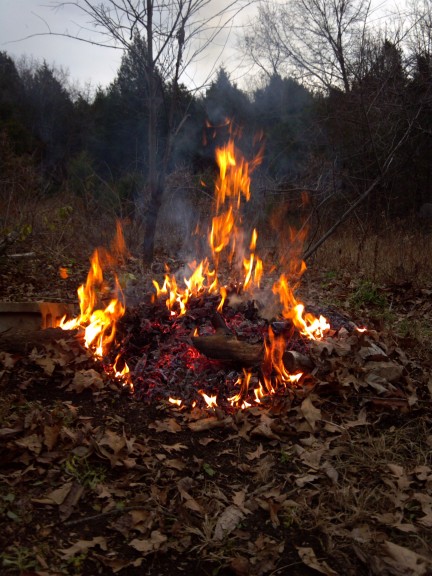
Well, now I am single so I do it all. Single is fine. I do what I want, go where I want, and spend all my money on myself. But it's not like you can ask friends to help you winterize. So I covered the plant beds in drifts of fallen leaves, and cleared the roof, lawn and walkways of fallen and broken limbs and branches, chopped and sawed them if they were too heavy to drag, then dragged them into a pile near the fire bowl. Oh yeah, and I got the stepladder and sprayed the satellite dish with Pam because HughesNet told me it keeps ice from sticking on it. Fortunately it was 56 degrees F, my kind of December 3, and I decided to make my first fire on my own. Before today I'd never had the urge or the heart. Kept bringing it fallen branches and raked-up leaves; it was ravenous for them and the larger the fire the more I was cheered, and began to hear in my mind the lyrics "See the blazing Yule before us," and "heedless of the wind and weather."
Wednesday, November 9, 2011
Wild Turkey on the Wing

Monday, May 30, 2011
Song of the Cicadas
The band you will shortly hear is called "The 13-Year Cicadas" and these cicadas singing their #1 hit will rock your world, make yo' liver quiver and yo' knees freeze! The video, taken on the Timberstone trail, lasts 35 seconds. Be there or be square. http://www.youtube.com/watch?v=2k-dRyQJCBw
Monday, July 5, 2010
On the Trail
 To walk through a sturdy Missouri oak and hickory forest is a privilege. It is a mighty thing. This view, a path all paved with light, is along a steepish two-mile trail I walk often, near Rockwoods Range, never failing spring summer winter fall to halt in my tracks and marvel and wish I had been born in Missouri.
Subscribe to:
Posts (Atom)