Lilacs grow richly on the cliff edge -- and only on the cliff edge! -- and make quite a display for passersby on the highway below. During their brief springtime bloom, I get an armful or so for the house and porch and giveaways to the benighted who do not have lilacs. (How they got up here in a sand glade I don't know.) They rank with bluebirds and crocuses as one of my favorite things and one I will crawl onto a cliff edge for. Who wouldn't? As long as I can, I will, and I would grieve if I didn't.
This time the usual approach to the cliff edge was overgrown, already, with leafy understory junk shrubs and vines. Up a slope of tall grass with bits of sandstone gravel imploding under my treads, shouldering past an electrical pole, stepping over fallen logs and a patch of prickly pear cactus growing in a sandy microclimate one foot square -- never know what you'll find around here! -- keeping my balance, some lilacs were within my reach. The greater part of the display just swayed in the wind and laughed.
Lilacs are not Missouri native plants or even North American. They're from Eastern Europe and Asia. To whoever sneaked them over here, thank you, and I understand you completely.
Showing posts with label sandstone. Show all posts
Sunday, April 28, 2019
Tuesday, May 22, 2018
The Blocked Bridge on the LaBarque
![]() |
| Bridge over Doc Sargent Road |
Yet this was the first time I actually saw how one of the bridge's two ducts was clogged near to its "ceiling" with sand. Now I fully understand why in 2015 and 2017 the LaBarque, usually not much more than a stream, rose so quickly and forcefully over its banks and the adjacent road.
Seeing new and huge deposits of sand choking the creek, after those floods, did bother me, but it seems that Nature took care of them. This, though, I can't see a solution to.
Friday, February 24, 2017
What's Under There? This.
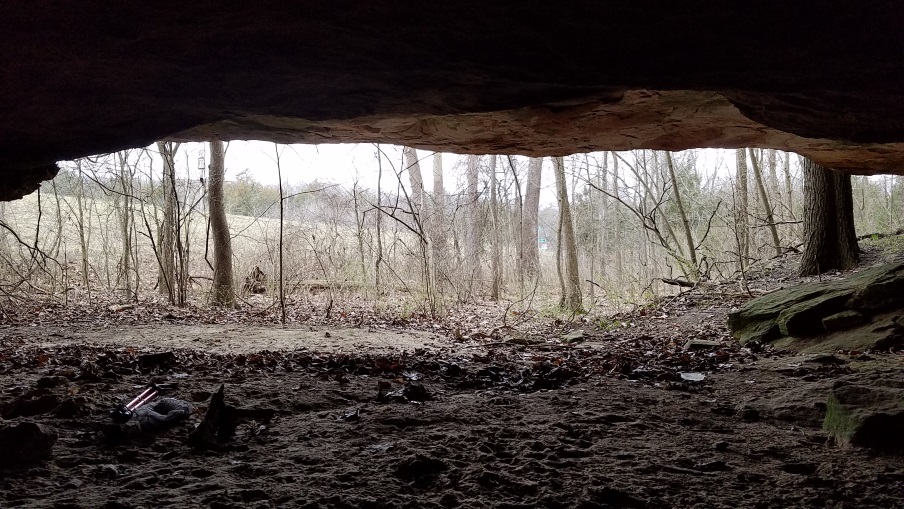
The Divine Cabin sits atop a bluff and from the road people can see, in winter and spring, what looks dramatically like a cave at the bluff's base. They actually park on the shoulder and walk on down there. It's so familiar I barely notice it, but I explored today so you can visit. In the above photo you can see in the left bottom corner my two three-foot hiking sticks, for scale, so the opening is about 30 feet. The "cave" goes back about 20 feet, and although you can walk in you must stoop and then crawl and then meet a solid wall without portals, so it's not a cave but merely sandstone rock that is vulnerable at that layer to weathering. There's daylight enough inside for photographs. Because it's a sandstone bluff its flooring is sand with fallen chunks of solid sandstone (this presents danger and is why it's off limits), and animal tracks, mostly opossum. I found a bone about 10 inches long. What is a cave without a bone? The bone also had teeth marks (see the close-up photo). Before the flood of '15, a fox den was nearby--but beneath the bluff is not a good animal hideout because there's only one way out, and for the climbers, nothing to climb. Claws can't climb sandstone.
The bluffs were cut by LaBarque Creek when it was ancient and higher. The LaBarque is now about 40 yards to the west, beyond those trees. A fox's den will always be near water. The bluffs are wet and green year-round and they used to form a swampy pond ("the secret pond") at their base, full of frogs in spring and summer, so many they climbed the cliff and up the side of my house and stuck on the bedroom window. The flood of '15 thickly covered the creek's silty margins with sand and evened it out so there's very little pond area. A two-minute video I made way back when, in 2011, preserves it.![]() | |
| What you see from the road |
Monday, April 6, 2015
My Peeps
Easter weekend had a theme. My sister Rose, brother-in-law, niece, and her boyfriend (they're 17) visited on Easter weekend and the niece had to see the baby chicks available for purchase at Dickey Bub's, so we went, and to our surprise some of the chicks had been dyed for Easter. A young employee held a chick so I could get a closeup. And my relatives love fossil-hunting and while out digging around my sister found a piece of Peep-shaped sandstone.
Not only this but today at Wal-Mart, chief among the leftover, 50-percent-off candy was rows and rows of multicolored marshmallow Peeps. One year I microwaved a Peep to see what would happen. It swells and grows bigger and bigger, about quadrupling in size, and then begins to burn.
Tuesday, October 14, 2008
Fossil Fields
The bed of the mighty LaBarque Creek is a motherlode of fossils and a rockhound's Eden. The rocks are a perfect Chex Mix of limestone, sandstone, shale, chert (som
etimes resembles arrowheads!), dolomite, hunks of iron, hardened clay, and marble. I find that the rocks with fossils are almost always turned fossil side up. Most fossils here are those of ancient marine plants, both simple and leafy, and simple animals, sort of like coral, called crinoids. My guess is that what you see in the close-up photo is crinoids. I don't know how or why I sleep when there is such cool stuff not 200 feet from my door.Tuesday, December 25, 2007
World's Largest Icicle

Wind carved out this white sandstone cave in my woods. The ledge on top is perhaps dolomite -- harder than sandstone -- and I've seen trickling rainwater make a nice delicate waterfall in spring. The dropoff is about 12-15 feet. In the cave you can camp, sit nice and dry behind the waterfall, and build a fire (see my stock of kindling at picture's lower left). I'm not the first who's done it. A few years ago, my niece dug in the sand and unearthed an old-fashioned silver spoon.
Yesterday I went out hunting with the camera. Good thing I had it, because I have never before seen a monster icicle like this one; minimum 12 feet long. A wonder. Compare with the kindling pile, or the trees in the photo for scale. Some folks try to create giant icicles by pouring water off their roofs. This one is 100 percent Mother Nature's.
Subscribe to:
Posts (Atom)