Showing posts with label father dunne's camp st. louis. Show all posts

Wednesday, April 14, 2021

Father Dunne's Camp: Memories from One Who Was There, 1960-64


Meet Mr. Richard DeVoto, well-named assistant to Monsignor Harry L. Byrne who directed Father Dunne's Catholic home for orphan boys, founded by Father Peter J. Dunne, himself a former orphan, in St. Louis in 1906. Byrne directed too a summer camp for the boys, open from 1941 to about 1971. 

The Divine property is near what's left of Father Dunne's camp. Mr. DeVoto shared memories of camp life from 1960 to 1964. DeVoto later did two tours in Vietnam and was employed by the Department of Natural Resources and the State Highway Patrol until retiring in 2014. "Lot of happy times here," he said about the camp, "lot of happy times." The videos were recorded in early autumn 2017.

Was there a school bus from St. Louis to the camp? Oh, no. Every year DeVoto drove a station wagon with seven campers at a time until all 40 were present.

"From breakfast til midnight" DeVoto was on call for his boss, who lived in a cottage on the grounds. Monsignor Byrne was "from money" and paid for camp fireworks on the Fourth of July, and for the boys' high-school graduation parties, and some of the boys' college tuitions, and "if something was for himself he always paid for it, always, out of his own pocket. In 1963 he had a 1956 Cadillac," DeVoto said, according to my notes. "He never mixed his money with anything. He was always giving me money -- twenties! Whoever back then had $20 bills?!" Monsignor kept a piano in his cottage's living room. "Everything was meticulous," DeVoto remembered. The back garden at the monsignor's cottage, walled with pink brick, overflowed with daylilies and petunias, Monsignor's favorite flowers. DeVoto was expected to serve cocktails to the monsignor and any adult guests at precisely 4:30 p.m., and dinner at 6:00.

Also on the scene were colorful characters such as the resident caretaker, Mr. Chilton, who "always did everything the hard way"-- like building a snowplow out of wood; a visiting priest from Kankakee constantly on the phone with his stockbroker; St. Louis Archbishop (later Cardinal) Joseph Ritter; and Brother Matthew from the nearby monastery at St. Joseph's Hill, an artist the monsignor commissioned to paint his portrait. In my early days in this area, I met Brother Matthew at St. Joseph's Hill and visited his hermitage -- filled to its ceiling with painted canvases.

Father Peter J. Dunne was born in 1870 and died in 1938; RKO Pictures made a movie about him, Fighting Father Dunne, starring Pat O'Brien, in 1948. Monsignor Harry L. Byrne directed Father Dunne's for 25 years, until 1969, and died in 2004 at age 95. Brother Matthew Gallagher died in 2007.

Sunday, January 24, 2016

The Artifacts

Today I brushed the dirt and moss from the artifacts I took from the dig, and what I thought was a belt made of webbing is not a belt. That is not a belt buckle. It's a flat hook, 1/4" thick and very weighty. This is a flat hook ratchet strap, used for securing cargo. The entire length, from the fraying on its opposite end to the outer edge of the hook, is 32.5 inches.
Here is the cleaned "hinge," looking inside it. I am stymied, having very little familiarity with hardware. Could the hollow end have been a latch or something? If you know, please post.

It's just more mystery. I'm waiting for the soil to be diggable again. Patrick has a metal detector which could be a great help. Waiting also for the Archdiocese of St. Louis to send me information about Father Dunne's Camp, and I found and ordered a VHS of the RKO film Fighting Father Dunne (1948) so I can at last see the Father Dunne movie. I'm going to have to refer to this particular Father Peter J. Dunne as Father Dunne (d. 1939), because there are at least two other priests, more recent, with the same name.

Friday, August 21, 2015

Doing the Deeds: Father Dunne's Camp

This property I live on was owned for 45 years by the Father Dunne’s Newsboys Home and Protectorate, a St. Louis Catholic charity that prefigured the more famous Boys Town. Dunne’s boys lived in the city but had a summer camp of 100 acres here. Dorm and dining facilities now in disrepair were dedicated in 1957, but exactly when the camp started, and who gave the land, was a mystery that sent me to the Jefferson County assessor’s office this morning, where I did the deeds, finally, after 14 years living here.

At the Registrar of Deeds, I found that the Father Dunne Newsboys Home and Protectorate’s camp had been sold for one dollar to the current landlord on 21 January 1986; the digitized records went back no farther. The older, oversized, weighty books of legal records, handwritten or typed, bound together by year, were in the archive. That room is chilly, and after the clerk copied me the 1986 deed, she pulled up on a monitor the digitized microfilm of all the Jefferson County deeds back to the 1860s and showed me how for each year I should search all the entries that began with the letter “F.”

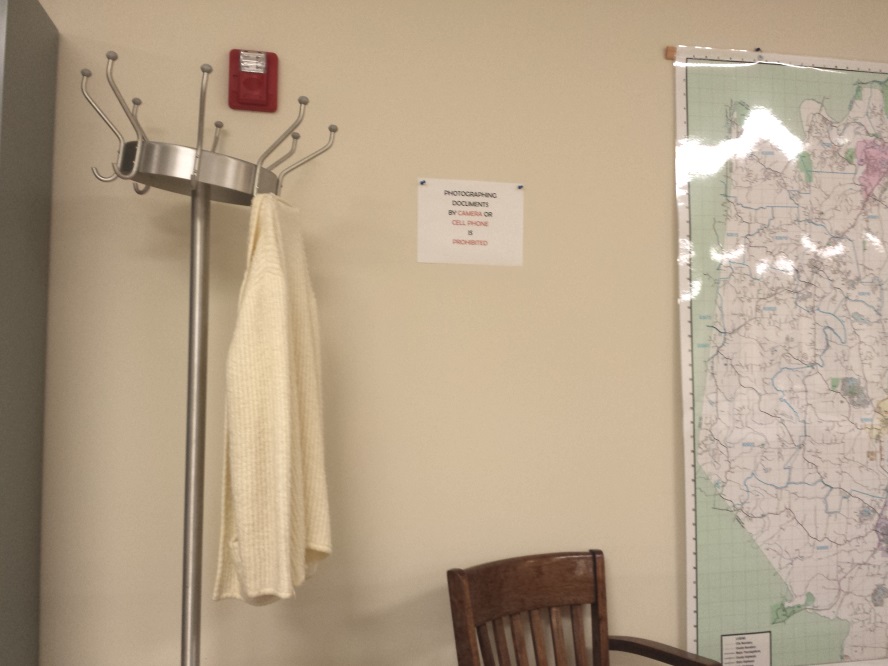
She’d worked with many historians and seekers. “People get cold in here, so if you need a sweater,” she said, then pointed to the coat rack where a lone cardigan hung, “use that one. That’s the ‘house’ sweater.” Only in Missouri.

The "house sweater" in case historians get cold.
Father Peter Dunne, an orphan who became a parish priest, sheltered his first homeless newsboy in 1906 and the shelter was running full tilt when Father Dunne died in 1939. “Old Newsboys Day,” Father Dunne’s fundraiser, is still held annually in St. Louis. Pat O’Brien starred in the RKO bio-pic Fighting Father Dunne (1948). Can’t find the movie. But I did find facts today about this 100-acre property:

-The house I rent was built circa 1935. It is 1070 square feet. The second house on the property was built circa 1960. There was a dorm-like building on this property in 1954, according to an Army Map Service topographic map.

-On March 31, 1941, Herman H. and Lillie M. Oberhaus sold 67.19 acres to Father Dunne’s Newsboys Home and Protectorate for $100. It would have been 80 acres total, but in April 1937 the Oberhauses had sold 12.81 acres of it to James R. and Gladys Murphy for $800. The price suggests that the Murphys bought a house on that property. In November 1938 a 15-foot easement was granted to Union Electric for electrification and tree-cutting.
-On June 26, 1942, William D. and Marie B. Walsh sold 40 acres to the Father Dunne Newsboys Home and Protectorate for $100.

As of June 1942 the Protectorate owned 107 contiguous acres and maybe established the camp then, but that doesn't explain the 1935 log cabin, built for summer residency. Perhaps the camp rented.

The property records are kept here.
The land was cheap because it’s good for nothing but a camp. Terrain is rocky, with dropoffs and steep-sided ravines and beneath an inch of soil is clay on sandstone. It’s so difficult that to this day AT&T refuses to extend its cable here.

Before today I knew only “lore” passed down through two previous tenants of my house (1986-91, 1991-2001), saying it was built around 1930 as the camp gatekeeper’s house. The keeper held the keys to the dorm, dining hall, and the gate, to which I held the key until it was dynamited for road widening in 2002. The camp closed in the 1970s, it is said because lots of little black orphan campers caused nearby residents to complain. Or maybe it was cost-prohibitive to remove the asbestos or bring the wiring up to code. Priests still used the camp’s pool as a vacation getaway in the 1980s; the first lease I signed required me to maintain the pool, covered and abandoned years before. The newer house on the property, my neighbor’s, is nicknamed “the monsignor’s house” and I need other records to learn who lived there.

Coincidentally, a friend had been a Father Dunne’s (later Catholic Charities) charge, living in the shelter downtown, and camped here in the summer of 1962; he was 12. Their baseball diamond was on LaBarque Creek floodplain now grown over, its backstop having collapsed completely about five years ago.

One day a man drove up saying he added the bedroom to the house in 1969. (It looks very 1969.) Another day an older priest drove up and wanted to revisit the property, if I said okay.

When the Jeff County assessor’s staff learned I was unraveling the story of my adorable house, they came forward with old files and photos that helped me more, plus the names of local historians, and which library held the books most likely to be helpful.